
Barracuda Point Explained
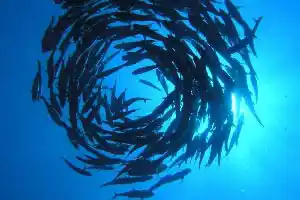
I've dived Barracuda Point more times than any other site on Earth and it still isn't routine. Some mornings it's a pleasant wall dive with sharks. Other mornings the water itself seems to organise and you're inside a rotating silver building. This post is about the difference.
Table of Contents
- Why one site carries a world ranking
- How the tornado forms
- When it forms
- How to dive it so it forms around you
- The finish: Coral Garden
Why one site carries a world ranking?
Dive-magazine top-fives are mostly marketing but Barracuda Point keeps earning its slot for a simple reason: density. A sheer wall dropping past 40 metres, a current-swept point where open ocean meets reef, resident whitetips stacked on the ledges, turtles at every depth you check and the school. Thousands of chevron barracuda, sometimes tens of thousands, holding station over one modest corner of one small island. There are prettier reefs. There is nowhere with more happening per minute.
How the tornado forms?
The schooling itself is defence. Barracuda pack tighter when their predators, chiefly the grey reef sharks that shadow the school, apply pressure and a tightly packed school in current naturally begins to rotate. Current is the engine: it concentrates food, holds the school on the point and gives the mass its slow cyclonic spin. No current usually means a looser, wandering school. Good current means geometry.
When it forms
Tide state matters more than clock time, which is why your dive centre's scheduling is half the battle; the point works best when water is actually moving across it. Early boats win more often here, first for light and second because the site gets its quietest, most natural behaviour before the day's full rotation of groups. If the vortex is your one wish for the trip, say so when you book and let the operator pick your permit day around the tides. It's exactly the sort of request we like getting.
How to dive it so it forms around you?
Counter-intuitive but true: the divers who get engulfed are the ones who stop chasing. Drop in, sort your buoyancy on the wall, drift with the group to the point and then hang. Mid-water, quiet fins, breathing slow. The school reads splashy, pursuing divers as pressure and keeps its distance; it reads a still diver as scenery and closes around you. Watch your depth and your air while you gawp, because the spectacle eats both and keep half an eye on the blue. The odd big visitor uses the same current you do.
The finish: Coral Garden
The classic profile ends shallow in the Coral Garden, off-gassing over hard coral in three-metre visibility of pure colour, usually with a turtle or four for company. It's the gentlest landing in diving. Where the site sits among the island's other walls is on our top dive sites page, and if you want your permit day aimed at the tornado, tell us and we'll plan around the tides.