
The Marine Life of Sipadan: What You’ll Actually See
Somewhere around my fourth month working here I stopped logging turtles. Not out of boredom, out of arithmetic: when a single dive produces twenty-plus sightings, the logbook column gives up. Here's an honest field guide to Sipadan's cast, from the guaranteed to the once-in-a-logbook.
Table of Contents
- Turtles: the ones you can count on
- Sharks on every dive
- The barracuda tornado
- Bumphead parrotfish at first light
- The rare ones
- Don't skip the small stuff
Turtles: the ones you can count on
Two species dominate, and telling them apart is a five-second skill. Green turtles are the big, round-faced grazers: smooth shell plates that don't overlap, one pair of scales between the eyes, and a general air of a retired gentleman mowing his lawn. Hawksbills are smaller and sharper. The beak-like face is built for prying sponges out of crevices, the shell plates overlap with serrated trailing edges, and there are two pairs of scales between the eyes. Behaviour gives them away faster than anatomy: greens crop seagrass and algae, hawksbills work the reef itself.
You'll see both resting on ledges, queueing at cleaning stations, and occasionally swimming straight at your dome port. Let them choose the distance. They always do anyway.
Sharks on every dive
Whitetip reef sharks are Sipadan's furniture. They rest on sand patches, stack under overhangs, and treat divers with magnificent indifference. Grey reef sharks patrol deeper along the drop-offs, leopard sharks turn up on the sandy shelves, and none of it requires luck. It's simply what twenty-plus years of real protection produces.
The barracuda tornado
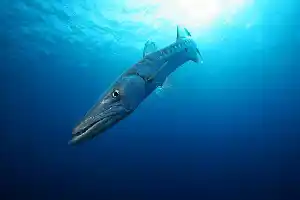
The image that sells a thousand trips: thousands of chevron barracuda schooling into a slow silver cyclone, sometimes wide enough to swallow a dive group whole. It forms most often at Barracuda Point when the current runs, and the schooling is generally read as a defence against the sharks that shadow it. My advice after hundreds of attempts: stop swimming. Hang quietly mid-water and let the school decide you're scenery. The days it forms around you are the days you'll bore your friends about for years.
Bumphead parrotfish at first light
Sipadan's other great school is stranger. Green bumphead parrotfish the size of coffee tables move in herds of fifty or more, audibly crunching coral as they graze; you hear them before you see them. Dawn dives give the best odds of meeting the whole squadron, which is one more argument for the early boat, as if you needed one.
The rare ones
Hammerheads pass the deep points occasionally, usually early, usually deep, with marginally better odds in the cooler-water months. Whale sharks cruise through unannounced a few times a year. Devil rays, eagle rays and dogtooth tuna round out the blue-water lottery. Nobody can promise these, and anyone who does is selling something. What the deep oceanic walls guarantee is that the door is always open.
Don't skip the small stuff
Between headline acts, the walls hold nudibranchs, ghost pipefish, scorpionfish and leaf fish for anyone who slows down. And the neighbouring islands take that to another level entirely; if macro is your thing, read my Mabul muck-diving guide and plan the non-Sipadan days properly. For the wider natural history, start with Sipadan facts.
Want the turtle-count-per-dive lifestyle for yourself? Our packages pair Sipadan permit days with the macro islands around it.